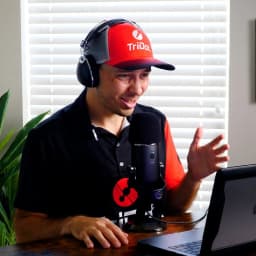
Episode 134
Fitness, Stress, & Readiness: Understanding Your Triathlon Training
April 18, 2022
If you love data and metrics, you won’t want to miss this episode! TriDot founder and CEO, Jeff Booher, and TriDot Coach, John Mayfield, discuss Fitness, Stress, and Readiness (FSR). TriDot's optimization manages the fitness you are building, the training stress you are facing, and the performance readiness you are achieving so that you can perform at your best, at just the right time, on race day. Learn about the components of FSR and how to see the gains you're making, literally right there in the chart, through TriDot's Optimized Training.
Hosted by Andrew Harley
Transcript
Intro: This is the TriDot podcast. TriDot uses your training data and genetic profile, combined with predictive analytics and artificial intelligence to optimize your training, giving you better results in less time with fewer injuries. Our podcast is here to educate, inspire, and entertain. We’ll talk all things triathlon with expert coaches and special guests. Join the conversation and let’s improve together.
Andrew Harley: Very cool episode today. Thanks for tuning in for it. Today, we’ll be talking about fitness, stress, and readiness with our experts breaking down TriDot’s methodology for measuring what is happening to your body each step of the way in a training cycle. It’s going to be great stuff. First up joining us for this conversation is TriDot founder and CEO Jeff Booher. Jeff is the chief architect behind TriDot’s insight optimization technology that powers TriDot. He’s a multiple time Ironman finisher and has been coaching since 2003 from the Olympic level to more than a dozen pro triathletes, multiple national champions and literally hundreds of amazing age-group athletes. Jeff, thanks so much for joining us today. Welcome back to the show.
Jeff Booher: Absolutely! It’s been a while. I was beginning to think maybe I’d been canceled or something.
Andrew: Beginning to think I should have invited you last week onto the potty cast episode. That would have been good.
Jeff: That was great.
Andrew: Also joining us today and also not on the potty cast was Coach John Mayfield. John is a USAT Level II and Ironman U certified coach who leads TriDot’s athlete services, ambassador, and coaching programs. He has coached hundreds of athletes ranging from first-timers to Kona qualifiers and professional triathletes. John has been using TriDot since 2010 and coaching with TriDot since 2012. John, are you ready to nerd out on some tri training metrics today?
John Mayfield: I suppose. I think it’s going to be tough. I mean, we have not only the potty cast, but several other episodes we’ve had recently have really been solid. So we’ve got a high bar to live up to. It’s kind of like we’re the ones having to follow up on that really killer act or something like that and I feel like, yeah, we’ve got to keep it going.
Andrew: I believe in you guys. It’s going to be great. I’m Andrew the Average Triathlete, Voice of the People and Captain of the Middle of the Pack. As always we'll roll through our warm up question, settle in for our main set conversation, and then wind things down with our cool down. Lots of good stuff, let's get to it!
Warm up theme: Time to warm up! Let’s get moving.
Andrew: Every winter, college football has its bowl season where most university football teams play their final game of the season in a bowl game. Some of these have national championship implications and the rest are largely for bragging rights. Every bowl game has a title sponsor or two and it’s become a punchline amongst college football fans in the US how ridiculous some of the bowl game names have become and how many games there are now. Bowl season has ballooned up to 44 games allowing 88 college football teams into the college postseason. A few of the bowl games in the 2021 bowl schedule were the roofclaim.com Boca Raton bowl where Western Kentucky beat Appalachia State 59 to 38, the Jimmy Kimmel LA Bowl presented by Stifel where Utah State beat Oregon State 24 to 13 and, my personal favorite, the Cheeze-It Bowl where Clemson beat Iowa State 20 to 13. Now, during the latest run of the college bowl games here in the US, TriDot Ambassador Brian Mull asked this question on the I AM TriDot Facebook group, “When are we going to see the TriDot Bowl? Are you really a company if you don’t have a bowl game?” I totally see Brian’s logic here. This comment of course was made in jest, but it got me wondering. If TriDot were to sponsor a sporting event as the title sponsor, what would you want it to be? And Jeff Booher, as our founder and CEO while I had you on the show I thought this was the perfect warm up question to ask you. If we were to sponsor a sporting event, what sporting event, Jeff, would you like to see us sponsor?
Jeff: That’s hilarious. Well, the obvious choice is a triathlon.
Andrew: Sure.
Jeff: You know, some big triathlon event, but baring the obvious, I thought of the Wing Bowl.
Andrew: Okay.
Jeff: Are you familiar with the Wing Bowl?
Andrew: I am not familiar with the Wing Bowl. Is it another college bowl?
Jeff: No. It’s competitive eating. It’s a sport.
Andrew: Awww…
Jeff: I know you’ve probably seen it, the hotdogs and all that kind of stuff. But there was a Wing Bowl that went for like 26 years in Philly and they eat as many wings– I think the reigning champion– I think they canceled it a few years back, but the reigning champion ate 51 wings in 30 minutes. She was incredible.
Andrew: Wow!
Jeff: She was incredible. I can’t remember her last name. Molly something.
John: I feel like I could do that. I think that’s in my wheelhouse.
Jeff: So I thought from a triathlon as much carbs and as much energy as we need and the calories…
Andrew: Sure.
Jeff: …let’s compliment all of that work with the Wing Bowl, competitive eating.
Andrew: Yeah. You know Nathan’s already has kind of a monopoly on the hotdog eating circuit as a sponsor, but yeah. We could be the title sponsor of the Wing Bowl brought to you by TriDot and I think it would take me probably a month to eat 51 wings personally, but you know some people have a different gift for eating than I do. So, John Mayfield, what is your answer here? What sporting event would you like to see TriDot be the title sponsor of?
John: So a lot of you are familiar with my background in golf and being a long-time golf fan. So just over the past weekend around Easter time had the Masters, but I am not going to claim the Masters simply because that one does…
Andrew: Oooo plot twist!
John: One of the cool things about the Masters, the Masters doesn’t need a sponsor. It’s got its own soundtrack and all that so it doesn’t need sponsors or anything like that. So I’m definitely not going to impede on the tradition that is The Masters, but the Houston Open for a long time was the Shell Houston Open, but the last couple years that event has not had a sponsor. So the PGA stop here in my home town of Houston currently doesn’t have a title sponsor, so perhaps it could be the TriDot Houston Open someday.
Andrew: Perhaps so and perhaps as a part of being the title sponsor we could write in the contract for John Mayfield to get a playing spot in the Houston Open where he would get destroyed by the actual PGA golfers, but that’s alright.
John: And it would be my first round of golf in like six years, but maybe I’ll… I think Bach would enjoy it a little bit more so Matt– Maybe we’d get to play. We’d put our foursome together and we’ll do that.
Andrew: Sure, yep. I here– I’m kind of taking a similar route John. I love tennis. All through my childhood, high school, college I was a fairly competitive tennis player in the state of Florida and I love watching the major tournaments every single year– the Grandslams, Wimbledon, US Open, French Open, and the Australian Open– actually this past year Kia, I drive a Kia vehicle, and Kia was a title sponsor for one of the tournaments. I forget which one now, but I was amped just to see the Kia logo all over the court and I was like, “Hey, I have that car!” So I would just be even more excited if there was a TriDot logo all over the background behind as Roger Feder is playing on the main court of Wimbledon or the US Open. So selfishly that would be my pick. Jeff, I feel like as a company, just strategically, it would be most strategic to sponsor something triathlon so we have to say that. I think it would be really cool to sponsor the Collins Cup. Of all the triathlon broadcasts I’ve watched over the past couple of years, between PTO and Super League Triathlon, Ironman, the tri world is getting better at broadcasting their races. The Couples Championship was just broadcast and in all the things I’ve watched the live broadcast for, the Collins Cup was so fun to watch. It was such a cool format. Just three pros duking it out at a time starting at different times. I don’t know. For TriDot to be the sponsor and see TriDot logos all over that, probably makes a little bit more sense than us sponsoring a wing eating competition or a tennis tournament or a golf tournament. So I’ll say the Collins Cup as well.
But guys, we’re going to throw this question out to you as we always do. With all the sporting events you watch, the crazy eating contests you watch, whatever you’re aware of out there in the world, if TriDot were to be the title sponsor of something, what would you want it to be? We’ll throw this question out to the I AM TriDot Facebook group so make sure you’re a member of that and I can’t wait to see what you have to say.
Main set theme: On to the main set. Going in 3…2…1…
DELTAG KETONES: Ketones are nature’s super fuel and the team here at TriDot has been learning from Oxford University Professor Kieran Clarke, founder and CEO of TdeltaS Global about the performance and health benefits of drinking the revolutionary Oxford Ketone Ester. My new favorite way to start the day is with a ketone boosted cup of coffee. It’s a must on those days where I need to be dialed in for anything from triathlon training to podcast recordings. The team at deltaG created the deltaGold Coffee Booster after research showed just how well ketones and caffeine work together. deltaGold Coffee Booster truly empowers you to start your day like there’s some extra watts firing in your brain. The team at deltaG even offers free 15 minute one-on-one consultations where you can learn more about fueling your workouts or starting your day with deltaGold Coffee Booster. You can book a call quick and easy at deltagketones.com. So head to the website, deltagketones.com and book your free 15 minute consultation. When you place your order, use code TriDot20 to get 20% off your super fueled ketone drinks.
Andrew: If you are a triathlete that loves this sport enough to listen to a guy named Andre the Average Triathlete talk about triathlon every single Monday, then you are definitely the kind of triathlete that likes to track your workouts and your progress as an athlete. In our sport, terms like fitness, training stress, peaking, recovery time, readiness, they’re all thrown around as we chit chat about our training, but have you ever stopped to consider how these terms are being used and whether or not they are helpful in examining our ability as an athlete? That’s what we’ll do today as Jeff and John talk us through fitness, stress, and readiness. Now guys, on the TriDot app under training metrics there is a whole tab that displays our fitness, stress, and readiness in what we call the FSR Chart. It’s been there for a while now and as an athlete, honestly, it’s just pretty cool to click on it and kind of peek at what’s going on as I built into some of my races last year. So start just kind of telling us this, what inspired the decision to give athletes a window by which to visualize their fitness?
Jeff: I think it started quite a while ago. There’s so many things that we want to show and to help athletes understand what they’re doing and why.
Andrew: Sure.
Jeff: I guess that’s the biggest thing behind it. You know, when you’re body building you know where your biceps is and your deltoid. You can point to things, but where do you point to your readiness or your fitness or your stress. They’re abstract.
Andrew: I can see that biceps getting bigger month to month to month. Sure. Yeah.
Jeff: There’s a quote I love. It’s, “You can’t solve a problem if you don’t have the words to describe it. You can’t even think about it clearly.” So it starts with the way that we define words and terms and when we’re innovating, pioneering in different areas, we’re very purposeful in that and then that word starts to shape the concept or how you think about solving the problem. Then from there, how do you visualize that? Where it’s an abstract thing that your affecting- fitness, stress, readiness- you know, how do you visualize that? How do you help people visualize it? So that’s kind of what the inspiration was to visualize it. Kind of stepping back, there’s a visualization, there’s a concept, and all the way back to the words in the understanding what those words mean so when you’re executing your training, you’re understanding the why behind it. When you’re committing to a week or a month or a week or month phase of training, you’re committing to that and it’s important to understand why are training loads going up and down, stress and all that to understand it better. So it all starts with the words. If you can’t understand what the words mean specifically. And I did a little research going into this. I’ve always been a nuance like that quote I said- “If you don’t have the words to describe something, you can’t solve a problem or think about it clearly.” I actually watched a TED Talk and the lady was talking about how words of different cultures shape the way those whole cultures think. You know, Native American tribes that didn’t have a word for ownership so they viewed things very differently, communally, than other people.
Andrew: Hmmm. Interesting. Yeah.
Jeff: I know even the word dialog, for us to communicate, I did some research on that and into the science of dialog. It means “through words or through reason” and that’s how we communicate. Without words you can’t reason and even in the Bible it talks about, “In the beginning was the word and the word was with God.” So there is this concept of a word bringing meaning. In legal contracts, up front they define this whole big- I mean it could be pages long of definitions of here’s what we mean when we use this word so there’s no ambiguity about it and you can’t argue later. You all agreed to that.
Andrew: You gave the Native American example of them not having a word for ownership. There’s also the flipside where a culture has more words for something than others.
Jeff: Absolutely.
Andrew: So to me as a Texan who was born in Florida, I have one word for snow and for our substantial amount of Canadian listeners and athletes who we love dearly, I know that Canadians, Inuit communities in Alaska and Canada, that they have tons of words to describe show because there’s different nuances there where as to me, it’s all just white snow. So it’s interesting like even the more you understand something, the more you know about something, the more words you typically have to describe that something.
Jeff: Absolutely. On that same TED Talk there is an Australian aborigine culture- I don’t know that you would call- a group of people anyway. They don’t use right and left to refer to directions. They use the like north, northwest.
Andrew: Okay.
Jeff: Like to my north, northwest. It doesn’t matter where you’re facing, it’s always to that direction and so you’d never say that. So every time you think about anything, you’re giving those directions. You’re not saying right or left. It’s not relative to anyone. So it doesn’t matter if we’re facing each other, we say the same direction.
Andrew: Okay.
Jeff: And she said those people actually don’t get lost like we do. Like if they’re in a building walking around a maze downtown and point to north by northeast, they’ll point because they are just oriented on that in the way that they think.
Andrew: Wow.
Jeff: It was fascinating. In our context, again, the whole thing all that legal, social it’s about those examples are to say how important it is that the words that we use are specific and accurate to convey ideas, express mentalities. So as we’re looking at words in training trying to solve training problems, improve fitness, improve efficiency of your training– when we’re doing that, it’s important to have those right words to solve those problems and then in this case, articulate that, visualize that so the people understand what is fitness? What is stress? What is readiness? What is a rest day? What is– you know these other terms so that we’re understanding so we can buy into and commit to our training. We can perform it better. We can get more out of it. So it just becomes very, very important. So kind of as we go through these I think seeing that importance helps us just to pause a second and really internalize, okay, what are the nuances of that and why does it matter to me?
Andrew: And it’s important to distinguish, TriDot since it’s inception has managed athlete’s fitness, athlete’s training stress, and how ready you are on race day, but behind the scenes. So it’s just for the first time there is actually a chart that athletes can visualize to see a little bit of what’s happening behind the scenes, correct?
Jeff: That’s correct. The word TriDot itself didn’t exist for the first five years of optimized training. There wasn’t a word TriDots. What are these– they’re the relative benchmark numbers to prepare you disciplines– swim, bike, and run– and that didn’t get a name until about 2009 or 2010.
Andrew: Very cool.
Jeff: But it was still in the background being done, but we just didn’t have to express it or communicate it to anyone so at the time it had a dumb name, but now it has something better–
Andrew: A better name.
Jeff: –something that we usually talk about. Yes. A better name.
Andrew: So in a few specific previous podcast episodes we’ve had some great discussion with our coaches about what is power? What is stamina? What is endurance? What does it mean to build these things? and a few other terms that relate to triathlon training. The first big one for today that we’re talking about is the word “fitness.” When we refer to an athlete’s fitness, what does that refer to say “our fitness,” “my fitness?”
Jeff: So first I’ll ask you– I think a lot of times it’s used correctly, but a lot of times it’s not. It is not a reference to your performance ability and that’s how I hear it used incorrectly. That’s often how it is. When someone will say, “Oh, my fitness isn’t where it should be so I don’t expect to do that good on this race.”
Andrew: Yeah. Yeah, yeah, yeah.
Jeff: Or heard things like that. Have you heard anything?
Andrew: So it’s funny you say that because it’s never the other side. You never have an athlete say “Oh, my fitness is so good. I’m going to destroy this race.” People don’t usually like– It’s always “Oh, my fitness isn’t where I want it to be so I’m kind of managing my expectations for this race.” It’s like, can we just put our training together the way we should so that we can have our fitness be where we want it? But yes, that’s the context where when athletes are just chit-chatting and they refer to their fitness, it’s “Man, I really just destroyed my 5K assessment. My run fitness has never been better.” It’s always in a context like that when you hear athletes talking and throwing around the word fitness.
Jeff: So that’s the first kind of differentiation point is separating performance ability from fitness. So there’s several classic examples. They’re all very similar. Physical fitness– so this is just even beyond training as athletes, but just general physical fitness– here’s the definition. Something very similar to this you’d find on the Internet. “The ability to carry out your daily tasks, work or play, with vigor and alertness, without undue fatigue, with ample energy to enjoy leisure time pursuits and meet unforeseen emergencies.” So that whole last part is “without the undue fatigue.”
Andrew: Sure.
Jeff: You can do fun stuff, you can do work, but the key part is “the ability to carry out your daily tasks, work and play, with vigor and alertness without undue fatigue.” So that is a description of your ability, your workload. So if we translate that to training, fitness is your ability to sustain a specific workload, sustain it that’s the daily, without undue fatigue. So ample energies to meet the demands of your regular daily life, your routine, maintain the state of good health, good mental well-being, you’re not getting burnt out. So fitness is your ability to sustain a specific workload without undue fatigue. It’s not how fast can you run a 5K. It’s not your 20K time trial. It’s not any of those things is not what fitness is describing. Those are all performance ability metrics and those are all race specific based on your duration, based on the race– you know, performance ability. So there’s that difference and they’re related. So we use a term called normalized training load to quantify your fitness. So that is the load that you are able to sustain without undue fatigue for a long period of time. The higher that load is, there’s a cost of maintaining that load. So the higher that value gets up there, relative to the person, you could spend all of your energy and all of your time maintaining a load– just doing the work and recovering from it and not get any faster. You could have a reduced training load, normalized training load, and actually be able to increase your fitness because you’re able to work harder on certain days, and you have these peaks. You know, you’re managing those other types of training stress more effectively.
Andrew: Yeah.
Jeff: So that training load needs to be relative to your ability, to your age, to the other things in life, your commitment to the sport, hours available to train. You know, all of that. So more is not better. More training load is not better necessarily.
Andrew: That makes me think, Jeff, when you put it in that context, I immediately think of like an athlete like Dwayne The Rock Johnson with his muscle mass versus Andrew The Average Triathlete and my muscle mass. He has to eat a certain amount of calories just to maintain the muscle mass that exists on his body.
Jeff: Exactly.
Andrew: And if I tried to eat the calories that he eats, I don’t need that many calories to sustain the muscle mass that is on my body and that’s what I kind of thought of there as you’re talking about just kind of the training load you need to maintain your current level of fitness.
Jeff: That’s exactly right. The calories is exactly the same. The other thing on the cardiovascular is there is an amount of exercise that it takes to do certain things to maintain that, so many calories to maintain your muscle mass in The Rock’s case, those calories can’t be used for other things.
Andrew: Yeah.
Jeff: You’re using so much of your available ability to adapt and improve is spent just maintaining that load and that’s what a lot of people don’t understand. So they’ll see these high volumes as better and I’m losing fitness. It doesn’t matter if you lose fitness if that’s what you need to do to increase performance. Your objective is to improve your performance, not to maintain a high load. But a lot of times people brag about their load. “I did this much this week.” And it becomes an ego thing, not really a performance improvement thing and they sabotage themselves. Then your fitness “level” is going to vary based on your daily task. Think about say if you’re recovering from an injury or an illness, in that time your load is different. A sedentary person versus a very active person, they’re going to have very different activity levels. Training for long versus short. There’s different training loads associated with the amount of work necessary to do that event and then relative to that, how much should you do to be able to improve your performance while carrying that training load to do that event. So that’s where the level of fitness should be moderated based on your ability, based on your age, based on all of these other things knowing how much potential you have to improve during that time. So that NTL needs to be high enough to allow you to safely complete the necessary training and also improve your performance ability not so much that you don’t have any capacity left to improve your performance ability.But on the flipside of that, unnecessarily high NTL can result, that can come at the expense of performance gains, at the expense of increased injury risk.
Andrew: Yeah.
Jeff: You’re not doing anything other than maintaining this high load. So it’s not a matter of how much you train or what that load is, but how you train. How you train is much, much, much more important than how much you train.
Andrew: Sure. Yeah. Which that harkens back to our cornerstone, podcast episode, The Power Stamina Paradox where we kind of learned about that; the nuances of that relationship between training– those times you need to take on a bigger load to train for a certain stamina versus just being able to work on your performance and train more to increase your power.
Jeff: Power or skill or form or any number of different things.
Andrew: So as we talk about stress, we’ve talked on the podcast before about how several of the popular stress tracking metrics are really just accumulation metrics. You know, they just tell you how much work you’ve been doing. Talk to us about the nuances of measuring training stress.
Jeff: There’s one aspect just with the NTS. So we have two categories I guess is the best way to approach it; a normalized training stress and residual training stress. So in that first category, the normalized training stress, that is not just an average intensity times your duration or anything simple like that. It’s actually looking at each sessions’ discipline type. There’s different amounts and different types of stress with swimming, biking, running. They’re different. The environment you’re in, you have to environment normalize that. Doing the same exact amount of work in heat and humidity or altitude is much different than sea level. There’s the intensity distribution. How is that distributed across time. If you do threshold for ten minutes, that second ten minutes is not just twice as hard as the first. It becomes exponentially harder the longer that you go over time and it depends again on your ability, your performance level, in doing that and what you’re able to sustain. Then the intensity levels themselves, going beyond threshold is not just 10% faster than your threshold pace is not 10% more stressful. Then the duration of each of those. So there’s how it’s broken up and then there’s your training stress profile. How well do you absorb stress genetically, your age, how long you’ve been doing the sport. So your ability to absorb it, the distribution of it, the duration of it, the type of it, the intensity level and how those rate in the discipline type. So we articulate and quantify all of that when we measure the stress and think of that NTS as– I think we have a whole podcast on this.
Andrew: We do have a whole podcast on NTS.
Jeff: So I’ll stop with that, but it's– think of NTS as quantifying a session’s stress. The physiological stress from that session. Like how hard was it? But everyone knows if you go and do a really hard threshold set and then you go do a really hard zone 6, like big gear work set. Those are going to have different residual effects over time. One you might be sore for days. The other you might be recovered in a couple of days. Even though they are both very hard, you couldn’t have gone any more on that day, but they are different. So RTS, residual training stress, measures that residual or that lingering effect after that workout and that’s going to affect different people differently. Like with the zones we’re measuring, neurological stress, muscular stress, aerobic stress, threshold stress. The older you get that neurological stress you don’t recover from as fast as some of the other types of stress so that may affect an older athlete more. So that RTS is also depicted on that graph, the FSR chart. So we really distinguish in those two ways. One is how much can an athlete take in the NTS, when we’re prescribing training. We’re also looking at the RTS associated with that. So what will the lingering effects of that be by discipline, by intensity, by duration, by intensity distribution, and all of those other factors. So that’s not just the RTS and there is different half-lifes for each of those intensity types. So they are going to decay that amount of stress. How quickly do you absorb it and recover from it? Different energy systems, different all of that. So as you do that–
Andrew: So Jeff, I want to– because I’ve heard you talk a lot more in depth about that before and it’s one of the most fascinating things to me as an athlete. Like when you talk about the half-life of training stress. So just to give people a tangible example, when you have a workout that takes you anaerobic into zone 5 and 6 versus just the training stress you get from going zone 2 and zone 3, what is the difference there in the half-life of the stress its putting on your body?
Jeff: Well, I don’t have specific numbers.
Andrew: Yeah, sure.
Jeff: It’s going to depend and it does vary based on the age and the genetics of the person, but think about you’re exercising and you’re straining putting stress on different systems. You’re stressing your cardiovascular system primarily. Others, you’re stressing your musculoskeletal system. So the others you’re stressing your nervous system. Sometimes you’re doing all of that. But as you do those different things, those different systems take different lengths of time to absorb that training. So you’re going to benefit from it. It may take longer to have that reaction from that; to absorb it and to get that triggered response that you’re looking for and then recover from it and being able to do it again.
Andrew: That’s fascinating.
Jeff: So again, back to your TSP, training stress profile. There’s values for each athlete on how much can you take in one session, how much can you take over a microcycle a week, or a mesocycle more like a month? Sometimes you can take a high dose, high single doses, but you can’t do it very often. Other athletes as they age, they can take it more consistently, but not a whole lot all at once. So optimizing that is key and you have to divide those out. NTS, normalized training stress for the session, RTS, residual training stress, after and then stride all those based on the type as well as the composition of that RTS value? So this chart just shows that kind of quantitatively where you can look at it and you can visualize and see what’s happening. You’ll see the spikes and the ups and downs associated with that you’ll see the lagging– the inverse relationship between the high degree of stress on one day and then your readiness drops the next. Again, you’ll see those relationships.
Andrew: Yep, I would encourage everybody to go back after you listen to the episode and next time you’re on your computer or your phone and you have TriDot pulled up on your computer or phone to look at the NTS chart, look at the FSR chart while listening to Jeff say that explanation about NTS and RTS and just toggle between the two and kind of get a visual for exactly what Jeff is talking about there because it is really interesting to see visualized. I’m a visual learner, right. I mean, there’s auditory learners, kinetic learners, and visual learners. I’m a visual learner so that’s just how I think in terms of taking what you’re hearing on a podcast and making it sink in. Now John, a little earlier Jeff alluded to the question “Do I need a rest day?” This is a question I hear from TriDot athletes, I see posted to the group from time to time. So since TriDot is tracking training stress and it’s quantifying what we all need day to day in our training, do we in fact need a rest day?
John: Absolutely. So I think this is going to come back to things that Jeff was talking about earlier and understanding and what are definitions and what do words mean. So do you need a rest day? Absolutely. I don’t think anyone is ever going to prescribe seven days a week of high intensity sessions for swimming, cycling, and running. So yes, you need a break from high intensity sessions in the swim, bike, and run every day of the week. So from there it’s really determining what does rest mean and what is that relative value to you? As we talked about before, rest for someone who is recovering from sickness or illness may mean not getting out of bed all day long. Rest is going to mean something different for someone that lives a sedentary lifestyle as opposed to someone who is training for an Ironman. So rest day is not necessarily a day off. We train in three disciplines and it’s pretty rare that you would actually have to do each of those, swim, bike, and run, in a day outside of a race. It may happen occasionally, but the vast majority of the time, you are engaging in one or two of the three disciplines. So technically every day is a rest day. For example, I have cycling on my training plan today. I’m not swimming, I’m not running so I am resting from those. I am resting those energy systems. I’m resting those specific physiologies. So in that regard, that is a rest day. So I’m not taking the entire day off because there is opportunity cost to that. So if I do nothing, then I’m not doing something else. I’m not doing training to make those gains. So a rest is a period of time where your RTS is allowed to decline. There are ebbs and flows to that. It is prudent for your residual training stress to come and go. That’s how we stress the body and then we allow the body to recover and it is done so in those times where RTS is down. For example, in the months leading up into an Ironman triathlon you’re going to be training under a heavy load. You’re going to have stressful sessions. You’re going to have long sessions. You’re not going to necessarily feel rested very often in that time and then that’s largely an expectation of Ironman training. Now once you get close to race day and you begin to taper, that is when it’s important to begin to feel more rested. So monitoring your readiness provides insights as to how your rest is planned. You’re going to see that ebb and flow within a microcycle. So you’re going to see those days where your training stress is higher where the NTS for a session is high. You may have a couple days in a row where you have a couple sessions that are a higher NTS and then you’re going to see a lower NTS values for those individual sessions and along with that you’re going to see that readiness ebb and flow as well up and down. So that’s where your rest is coming in and I think that’s also something that we can look forward to as an indication of what’s even coming in our training and how our training is laid out. A lot of times what we’ll see is an athlete say “I don’t feel completely great today so I’m going to back off the duration. I’m going to back off the intensity or I’m just going to skip a session because I feel tired.” Or maybe they’re looking at a metric that says you’re not yet recovered. Well, when you look at even like these readiness charts you can see that you’re not supposed to be ready. You’re not supposed to be race ready when your race is weeks or months away. You’re not supposed to be fully rested when you’re in the middle of a small cycle where you’re looking to make these adaptations through higher intensity, higher training stress sessions. So what you can see by looking at that chart is to say, well, yeah I’ve got two or three days here that are going to be tough. There’s going to be a good bit of training stress in these days, but the next two or three days that training stress is going to drop. The RTS is going to go down. RTS7 is going to drop and inverse to that, that readiness is going to go up and that’s going to be indicative of rest and recovery adaptation from those days of training. So if you’re using some of those even in a real time, would be the right word, but it’s not always– even if you don’t necessarily feel like doing the session, that doesn’t mean you shouldn’t do it. Obviously we want to be safe and prudent. Make safe and smart adaptations, but just because I did a hard session yesterday and I’m feeling it today, that doesn’t necessarily mean that you skip or reduce or modify today’s session because of that. AGain, this is just a graphical representation of what’s happening in your training and provides some insights as to how your training is flowing because that’s basically how we increase our performance ability is measured stress to the body and then allowing the body to recover and make those adaptations.
Andrew: Yeah, I absolutely just 10/10 John, love the explanation of the different training between a rest day and a day off. Those two are not the same and I think of– there’s been several times that I’ve gone into a Sunday run workout and my legs were blasted from the previous day’s bike workout and I thought to myself, “How does TriDot think I’m supposed to do this run workout?” Like I feel tired, my body hurts, and you go out there and you start running and you go through the run warmup exercises and you get your body moving and you actually destroy that Sunday run workout because TriDot knew that the system you were using the day prior was different than the system you were using that day for that particular run and you have ability in there that even though you necessarily weren’t feeling it, you can certainly do more than you think you can on certain days and the way it’s all timed is fascinating. Yeah, if I have a tough Thursday bike workout and then swimming the next day, my legs can be fatigued from that bike workout, but they don’t need a full day off to do a swim. So super, super helpful there John on all that.
John: Something you see pretty often is oftentimes– especially newer athletes there’s a, it makes sense to take that day off and to have a day where there is no training, no activity, to allow for that full recovery, but kind of the rule of thumb that kind of flips that is when your training is properly balanced, when the frequency of workouts is optimized, when the sequence of those workouts is optimized, when you’re training at the proper volumes, when you’re training at the proper intensities, all those things that TriDot’s optimization does for each individual is you can train seven days perpetually. Using myself as an example, I have been training with TriDot for more than ten years and the vast majority of that time I have trained seven days a week for weeks on end and been doing so successfully without injury, without illness. I’ve never gotten into a situation where I felt like I was over training. However, I do train seven days a week and really when we look at optimized training there is a certain amount of training that is appropriate for each individual given their objectives, their abilities, all that. So there is a certain amount of work that needs to be done, a certain amount of volume, a certain amount of intensity. So when we limit that to six days in a week, that doesn’t necessarily change the amount of work. That doesn’t change the amount of sessions that are needed to be done, the amount of work we need to do. It just limits the amount of time we have to do it. So instead of having seven days to do all that work, we’re now limited to doing that same amount of work in six days. So it’s– think about like when you have a wonderful three day weekend, for most of us in our careers that doesn’t mean we only have four days of work to do. As much as we enjoy those four day work weeks, that doesn’t mean we only have four days of work.
Andrew: Sure.
John: It just limits the time we have. So if you’re out for a day, you know everyone enjoys the occasional day off, but again oftentimes when we come back that means there’s that much we have to play catchup. That first day we end up doing two days’ worth of work. It’s very similar in our training like that. So if we limit how many days we have to train either 1) we are missing out on opportunities. We are not doing the optimized amount of training sessions or the optimized amount of training. or we have to then double up. And there are certainly times where it makes sense to do that. There are certain athletes, there are certain times in our lives where we don’t have availability of seven days and we can absolutely make that work, but as a rule, the kind of best case scenario is taking advantage of all seven days to get in your training.
Andrew: The R in FSR stands for readiness. Now I like thinking about my readiness as an athlete because the term just transports me from my podcasting chair to the race day starting line. When I think of being ready I picture myself on the start line, well trained, feeling great, and ready to destroy. But scientifically, guys, what is readiness and how do we measure it?
John: So performance readiness is a metric that describes your state of recovery and ability to perform at your best. It’s a 1 to 10 scale with 10 being the most ready to perform. So it is derived from your NTL, your RTS, your RTS7 among other factors. So again, it’s just giving you a representation, a quantification, of how ready you are to go out and perform. It’s again a 1 to 10 scale that can be broken down. Like 1 and 2 would be very low readiness, 3 and 4 would be low, 5 to 6 moderate, 7 to 8 high, and 9 to 10 is very high. So both that high of 7 to 8 and very high 9 to 10 are good. So as you are approaching race day that is obviously the most important time to be ready.
Andrew: Sure, yeah.
John: To have that higher number realized, but there’s largely an inverse relationship with your readiness number and your performance gains. So when you are doing t6hat work that is going to produce the readiness and produce that race day performance, you’re not going to be ready. So you kind of have that inverse relationship with that. So largely throughout your training as a rule, you’re going to see those lower numbers because you’re not ready to perform. You’re doing work that is going to eventually get you ready and that work that you are doing is preventing you from being ready. So that’s where that reduction in RTS, the reduction in RTS7 allows for the increase in readiness. So again, we’re dropping the training load so that the body can heal, rest, recover, and be ready to perform at its best on race day.
Andrew: John, can we institut like a -2 on this. I know it goes 1 to 10 right now, but if we can add like a -1 or a -2 and have that be like, “You broke yourself! Do not race today!”
John: I’ve thought about bringing that up, that there’s not a negative number.
Andrew: To me it would be more for comedic value than actual. I think you guys nailed it with the 1 to 10 scale. That’s probably plenty, but you know, just particularly for athletes who are training, doing the right training right with TriDot, you’re not going to be at risk of putting yourself at a negative value of readiness. So just scientifically, that readiness number, because again, I hear the word readiness and it’s like, how do you mathematically quantify how ready somebody is? So it’s taking the NTL, your normalized training load, the RTS which is your residual training stress, and the RTS7, your seven day residual training stress average, and it’s using those numbers to configure and quantify how ready you are which is super cool. Am I understanding that right?
Jeff: That’s right. There’s other things that factor in there. Obviously there’s more to being ready.
Andrew: Sure.
Jeff: I mean, mentally, emotionally, and there’s all these other things that we don’t have data, but as far as the data goes, the things that we can manage, manipulate, and optimize for the athlete, yeah.
Andrew: Now that we’ve come to a clear understanding of fitness, stress, and readiness as terms and training concepts, let’s talk about reading the FSR chart. Jeff, what do we need to know to understand what we’re looking at? The first time I ever pulled this thing up, there’s several different bars and graphs and colors going across it and it took me a second to get my bearings. So help us get our bearings here. What do we need to know to read this chart?
Jeff: Backing up one step, if this whole thing like blows your mind, if it’s over your head, if it’s like “I don’t want it” personality, don’t look at it.
Andrew: Sure. Yeah.
Jeff: Know that it’s being done.
Andrew: Absolutely.
Jeff: Know that your training you’re going to be ready, all these things are happening. So you don’t need to look at it. So this is for athletes that whether intrigue or motivation or just want to better understand. I think, I don’t know if its 50/50, but a portion of athletes are like I want to understand. I want to know that it’s happening and I want to get up and take my medicine, do my workout and I’m good. So if you’re in that category, you know, more power to you. That’s great. For others if you’re going to look at it, there is a page on predictive.fit website that talks about the FSR chart under the optimized training and kind of walks through screenshots of the different things and points out some of the stuff that we’ve talked about on the podcast. The first thing you’ll notice in the chart is you can break it down like John mentioned, based on discipline all together or one, just pick them out, and it shows you not only what you have done in the past, but it shows you the future. Here’s what your optimized training going forward is going to look like and so you’re able to see what’s coming up, see your training load go up or down, readiness and all those values. So you can also go to the bottom in the legend and click on the different metrics. There’s the RTS, RTS7 which is a rolling average of the RTS, and the NTL normalized training load– So RTS is a pink line. That’s the hot. It’s the stress. RTS7 is the seven day rolling average. Then there’s kind of a shaded background of blue, that is the load. That’s the load that you’re carrying over time. It’s about 42 days. It’s a weighted average based on the time. It’s not a simple weighting. Then the last is the readiness, that’s the green line. So you see that inverse relationship between the RTS when you have a lot of stress all of a sudden your readiness goes way down and then it will gradually come back up. Then another injection of stress and the RTS goes down.
Andrew: And that’s okay. That’s what it’s designed to do. So don’t panic when you see that green line go down.
Jeff: That’s exactly right.
Andrew: That just means that you’re in a training spot where you’re supposed to be taking on more stress and thus not being as ready to perform.
Jeff: Yep. So you can go to the chart and click on one. Just, I want to see one of them at a time and look at just the stress or just the training, your normalized training load and just kind of see it and it will help you grasp and understand what you’re doing and see when and why. You know, when you’re building stamina that’s when your training load is going to go up. When you’re building more your power, that’s going to be a little lower. As your race approaches– and all of us again, those are generalities. It depends on your performance level. If you’re running–
Andrew: Sure.
Jeff: –a sub four hour half, things are going to look different than if you’re doing that in seven hours.
Andrew: Yeah.
Jeff: So everything is relative. But yeah. It’s pretty intuitive if you walk through it. Then again, there’s a written form on predictive.fit site, this podcast, and then I think if you just play with it you should be able to make sense of it and hopefully it’s very meaningful for you to visualize it. Like, you’re a visual learner. I’m the same way. You go into your workout you kind of understand as you see things changing from week to week.You understand what’s going on and why.
Andrew: Yeah and to your point about like, this is there for you to learn from if you want to learn from it. So I personally, I mean just a normal training week, normal month-to-month, I don’t go and look at the fitness, stress, and readiness chart every single day, every single week. I would peak at it once in a while when I was kind of building up to Ironman Waco because it was really interesting to see for the swim, bike and run how the metrics would move in relation to each other and how when I would take on more of a load, when I was more ready and less ready. It was just really kind of cool to see while you’re in that race prep phase, but day-to-day, week-to-week you’ve just got to log onto TriDot, execute your training, you don’t have to look at it by any means. It’s just interesting to look at for those of you who really want to nerd out. So, John, when we’re looking at the FSR chart, Jeff kind of alluded, there’s a couple of toggles that we can do. We can toggle between looking at the swim, bike, and run. We can see all three sports aggregate at once. We can adjust which of the metrics that we’re seeing or looking at and see any of them in isolation. So John, what tips do you have for our athletes today for using these buttons and viewing options that are available to us?
John: You guys have said and alluded to it. I think the first thing to keep in mind when looking at your FSR is this is just informational. Basically the left side of the screen, or I guess maybe Jeff as the aborigines would say, the west side of the screen, that’s in the past. That’s what happened. That’s more of that descriptive data. That’s from your training files and that’s what you did. Then to the right or to the east that is where you’re going. So this is just informational. It’s a graphical representation of your training cycles and really what is looking to be achieved or what is planned for your training over the next few days, few weeks, months. You can scroll out and actually see much larger time periods, but there’s nothing required of you. So this is done automatically as Jeff said. This is just a representation of what the optimization is doing for you. Fortunately, we don’t have to make training decisions based on this information. So all of that is done through the optimization engine. So again, it’s largely informational for those that enjoy learning more and seeing more about their training. I recommend to those new to the FSR chart and those that are looking at it perhaps for the first time is to first break it down by discipline to make it more digestible. So you can again look at all these metrics across the swim, bike, and run in one chart, but it is going to be a little bit easier to see and draw relevant conclusions from if you’re looking at just the swim, just the bike, just the run. There will be a little bit more contex, a little bit easier to understand. Even looking back and thinking back over the training that you’ve done– again the left half of the screen is going to be what you did most recently. So you can know– you know what you did and think about you had a couple stressful, high intensity training sessions and then I had a couple easy days. Maybe I took a day off or missed a day. You’re going to see that represented in there in really impacting all of these metrics. So break it down by swim, bike, run and even then you can look at the individual metrics one at a time as well. So kind of as Jeff mentioned, going back and referring to that article that defines each one of these. Look at each one on just that one and understand what that means and you’ll understand now. Yeah, I see the impact of this. I see what my training was, why it was that way, and now I can see going forward that it’s going to be what it is. Also it’s important to understand the context of the season that you’re in. What is the objective of what you’re doing right now and then what is coming up. So obviously if you are in an early season development phase, that’s going to be very different than if you are in a race prep phase say six, eight weeks out from a long course triathlon. All these metrics are going to look different and you can see from a high level where you’re going. So if you’re in the early season where you’re working on that fast and strong portion of fast before far, strong before long, then you can see later in the season as those long course races approach where your metrics are going to be different because your objective is different. You go from really focusing on power and speed to going long and going far. So it’s kind of neat to see all of that so just have that understanding of what are these metrics what are they telling me? Look at it one at a time and then you can look at them all together and kind of get kind of the big picture of what’s going on with your training.
Andrew: Now athletes that use a Garmin watch or a cycling computer are very familiar with their Garmin telling them whether or not their training was productive or unproductive. Garmin devices will also tell you how long you should recover before your next session. For example, after my 5-½ mile run yesterday, Garmin told me I should recover for 47 hours which is unrealistic in my opinion. So many platforms, right, beyond Garmin. I used Garmin as an example, but many platforms and devices have similar suggestions and charts to tell us how much training that we’ve done lately– are these kinds of prompts helpful and worth monitoring and worth listening to or should we largely just do our training and only monitor our FSR values on TriDot?
Jeff: I’d say, maybe just none of the above. I’d say just do your training. I love Garmin. I love them. They’re wonderful. There’s a lot of great device manufacturing companies out there. We’ve used them the longest.
Andrew: World class leading devices.
Jeff: Great quality.
Andrew: Yeah.
Jeff: So no knock on them at all, but they don’t optimize training.
Andrew: Yeah.
Jeff: I think just doing your training, doing what
you’re supposed to do is the best way. You don’t need to keep coming
back to the FSR chart. It’s just showing you to help you understand and
conceptualize what’s going on. So just do your training. The reason I
guess that I’d say focus on that, I won’t even say just ignore the
others, but we’re doing things that they’re not. They don’t measure
training stress like we do. They don’t look at it by intensity type,
duration, genetics, the distribution of it, the incremental value.
They’re not looking at environment normalized or any of those things to
look at the training stress. Therefore, they’re also not looking at the
residual training stress. Measuring that, measuring half-life by energy
system, by age, all that. They’re not doing that. They’re not
normalizing when you do a workout in the different times of day. It’s
taking an after workout in the heat and humidity is the same as a
morning workout in the cool. It’s not looking at that. It’s not looking
at genetics. It’s not looking at– it doesn’t know what’s coming up. It
doesn’t know what your future plans are so how rested?
Do you need to be fully rested? Do you need to be partially rested? What
are the next week or two weeks of training that we have planned for you?
That’s going to dictate what you do and how much you rest and partial or
full recovery. Then they don’t optimize going forward. They’re not using
a data set. They’re not normalizing across all these people where
they’re able to quantify all those things to find those algorithms that
are going to optimize your training. So all of that is unique to TriDot.
That’s what we do. So I say trust your training. We’re optimizing it.
TriDot works and do that. So it’s not really a knock on anyone else nor
is it– keep watching it. It’s like you want to lose weight, you don’t
weigh every two hours and look at the scale. What is it? Have I lost
weight yet? Whatever that metric is, just don’t get hung up on that. Do
your training that is prescribed for you every day to the best of your
ability and you’re good.
Andrew: So we know there are ebbs and flows to our season as we build power and stamina at different times. The training morphs a bit as we slide in and out of race prep and development phases. What will we see on the FSR chart as we go in and out of race prep phases and development phases?
John: You’re going to see those ebbs and flows. It’s going to look a little bit like a mountain range kind of depending on what your schedule looks like. So I’m looking at mine currently. So my season for the year, I’ve got an Ironman race in June and I came off a pretty low training volume back in December. I had surgery so I was out for several days and then kind of had a slow ramp back up as I was recovering from surgery. So I started at a very low number back in December and then what needed to happen was my– I wasn’t in my race prep phase yet. I wasn’t having those incrementally longer sessions to prepare me for the Ironman distance, but I did need to increase my training load so that I could do that training at the appropriate time. So what we see in my chart is basically from December, January, February, my NTL increasing. So what that was doing was preparing me for those future training sessions. So from there it largely leveled off as I completed my development phase. Now of course, there are these other metrics that are more acute peaks and valleys. So even within the individual sessions you would have those spikes and recoveries, but kind of at a high level what we’re seeing is early in the year my training load built to that steady level to support my future training load. So then just in the last couple weeks here in March and into April I really started into training specifically for that Ironman distance race. So I started having those incrementally longer training sessions. So what I see now is beginning to increase that NTL. All those other metrics are also increasing. So the RTS, the RTS7, those are increasing as well. Then if I look forward I can see that NTL has a peak right there around race day, but again fortunately at the same time, readiness is also hitting a high there. So throughout those times, that readiness number comes and goes, but it says relatively low, but then as race day approaches it gets back there up into that high 10 value. But even within there you can see your microcycles, your weeks within those macrocycles, the larger ones. So generally what we see are a few weeks, two to three weeks, of increasing and then there’s that recovery week where your RTS is down, RTS7 is coming down, your recovery is going up, your readiness is going up. So you’re going to see those ebbs and flows represented within that chart and again it’s kind of cool to zoom out and see a larger time period. I think that’s also a good tip for beginners. Sometimes it’s easier to look at a couple macrocycles, a couple months, and even like an entire year to see here’s where I’m starting and then I’ve got this big race where my training load is going to be high, my stress is going to be high leading into that, but then my readiness is also going to be high at the end of that phase.
Cool down theme: Great set everyone! Let’s cool down.
Andrew: Last week on the podcast we had our Wordle warmup question where we asked, if the TriDot software engineers were to make a triathlon version of Wordle called Tridle, what word would you chose to throw out there next if you were in charge of the daily Tridle word? Now we got a ton of great responses really highlighting how many five letters there are in our sport. Jeff, John, I know both of you gents are Wordlers so if were up to you, what word would you choose in a game called Tridle? Jeff Booher, what do you think?
Jeff: Faith. In a couple different aspects. One is your why. Like why do you do that? What is your bigger than you purpose…
Andrew: Sure.
Jeff: …of doing it. And then the other is faith in yourself and that you can do it.
Andrew: Sure.
Jeff: And believing that you can overcome, that you can accomplish and you have to have that faith in yourself, in the process, in your support group, your family, you know, all of those things.
Andrew: Alright, very good. Absolutely love it and John Mayfield, what would you pick here?
John: So I would pick one that kind of stabs at the type A personality of most triathletes that I would infuriate everyone perhaps. So I’m going to go with a word that’s not technically a word.
Andrew: Okay.
John: It’s more of a– but it kind of has become in our vernacular. So going back to our very first discussion of words and meanings, most of our users understand and know what DTRTR is. So I’m going to go with doing the right training right abbreviated down to no vowels and to be like where are the vowels that’s in the word? So yeah. I’m sure a lot of people will be really upset and I would really enjoy that and mabe break some streets or something. So on the podcast last week you mentioned several other alternatives to Wordle like Tridle would be.
Andrew: Yeah.
John: There’s one that I play called Weezle that is for Weezer fans and it’s all words that are within Weezer songs and there was one the other day that was misspelled.
Jeff: I have no idea what that is.
John: And I was largely indignant, I was like that is not how you spell that word. It was like a six letter word that they had like crammed into five letters. So I kept playing. So it didn’t stop me. So I’m going to go with DTRTR, doing the right training right.
Andrew: Alright. Very good.
Jeff: What is Weezer?
John: Weezer is a band.
Andrew: Yeah, Weezer’s a band.
Jeff: Okay. Alright.
Andrew: Rally popular for John’s era of music lovers. I like Weezer’s recent cover of Africa. That was good. Yeah. I play Worldle which isn’t even a word game. They give you like the outline of a country and you have to guess what country you think it is and then each time you guess they tell you how far away you are and in which direction the actual country is. So even if you have no idea by the outline what country you’re looking at you can kind of sometimes narrow it down just by making geographically smart guesses. So I do that one and really enjoy it. Anyway. Tons of great options out there. there should absolutely be a Tridle. I’ll have to get the TriDot software engineers on this ASAP because it’s so important to have this. So our users threw out several great options and I asked both of you guys to go take a look at what people said to this question and all three of us have come with our three favorite responses on what the TriDot audience had to say. So John Mayfield, what were the three things that our users said, the three words they threw out there that you just really loved?
John: I went with kind of the high end, the finer points of triathlon. Chafe, vomit, and cramp.
Andrew: So you went with like the negative things. Like the downsides of triathlon.
John: It’s all about perspective. You know, negatives/positives. Rewards for a race well run. I mean, however you look at it.
Andrew: Okay. Alright. Chafe, vomit, and cramp. Yeah, that sounds like a law firm or something. I picked a couple here. The first one a guy said shirt and medal because those are the two reasons why we do this, right? You do it for the shirt and you do it for the medal. Both five letter words. Now my answer to this question was carbs because I love carbs and so a lot of people went the food route as well. They were totally tracking with me. We had users say toast. We had users say pizza. We had a user say Oreos and one of our TriDot ambassadors said ester which will please our friends at deltaG. You know the deltaG Ketone Ester is a great way to fuel your training and racing. So all fuel things there.
John: Now I will say that toast for me is much more a description of how I feel rather than what I eat.
Andrew: Sure, yep. Also true. The other one that I really liked that I don’t even know how to say this word. It’s P-S-O-A-S. It’s like the muscle near your hip flexor.
Jeff: Psoas.
Andrew: Are you guys familiar with that? Psoas, is that how you says it?
Jeff: Yep.
Andrew: So your psoas.
John: It’s where abs comes from.
Andrew: That would 100% have tripped me up. There’s no way I would have guess that word in 1000 years which is why I thought it was a very, very clever pick by one of our athletes. Jeff Booher, close us out today. What were the three audience suggestions for Tridle words that you liked the most?
Jeff: I really liked learn. I thought that was great. Learn about yourself and the sport. Trots and I’m not sure if that was a verb or a noun. Like she trots to her transition spot or he had the trots all morning.
Andrew: I remember reading that one. So that athlete specifically, Jeff, they put trots down after listening to last week’s podcast episode. So that was definitely trots as in I’m going to go to the potty and drop some, which potty was also a five letter word somebody suggested. But yeah, that was the trots as in #2.
Jeff: Just saw the list. So the last one, classic triathlon word, brick.
Andrew: Umm yeah.
Jeff: Gotta love it.
Andrew: Well that’s it for today folks. I want to thank TriDot founder Jeff Booher and Coach John Mayfield for talking fitness, stress, and readiness with us today. Shoutout to deltaG for partnering with us on today’s episode. Head to their website, deltagketones.com to learn more about fueling with ketones and book your free 15 minute consultation. When you place an order, use code TRIDOT20 to get 20% off your super fueled ketone drinks. Enjoying the podcast? Have any triathlon questions or topics you want to hear us talk about? Head to tridot.com/podcast and click on submit feedback to let us know what you’re thinking. We’ll have a new show coming your way soon. Until then, Happy Training!
Outro: Thanks for joining us. Make sure to subscribe and share the TriDot podcast with your triathlon crew. For more great tri content and community, connect with us on Facebook, YouTube, and Instagram. Ready to optimize your training? Head to TriDot.com and start your free trial today! TriDot – the obvious and automatic choice for triathlon training.